Or can we say . . the heroine’s journey? the She-ra-oine’s journey?
I’ve been stuck on She-ra and the Princesses of Power since the last season came out two weeks ago. There’s a lot to love about this show, but I’m mostly just enamored with the craftsmanship of the story.
If you haven’t figured it out by now, I’m about to SPOIL ALL OF SHE-RA.
Yes, I acknowledge it is meant for younger viewers: there’s a full plate of Winning with the POwEr Of FrIeNdShIP, tempered by clever dialog and strong character development. In the first four seasons, almost every episode balances two sides of the major conflict between good and evil, with the ‘Hero’ characters tackling positive aspects of a theme, providing the most teachable moments masquerading as emotional conflicts with quick resolutions. The ‘Villain’ side of the story is mostly mirrored plot points that build fascinating character dynamics and Game-of-Thones-worthy drama, completely free of the ‘quick clean-up’ apologies and reliance on teamwork as a resolution. The main villain of the story is deeply relatable, and the relationship between her and the main hero is an emotional rollercoaster that gets the audience to hope for a happy ending and dream of a gratifying redemption, while fearing that it neither may be possible.
HAVE I CONVINCED YOU TO FIRE UP NETFLIX AND WATCH IT YET? Ok I’ll bring up one more point: the representation game is strong with this one. She-ra features stable same-sex couples, as well as diverse body types and backgrounds. If you’ve ever felt that a comfort food show featuring lesbian relationships was missing from your life . . . don’t let me spoil it for you. Just watch it!
BELOW BE THE SPOILERS!!!!
————————————BEWARE, YE WHO HAVE NOT WATCHED SHE-RA YET————————
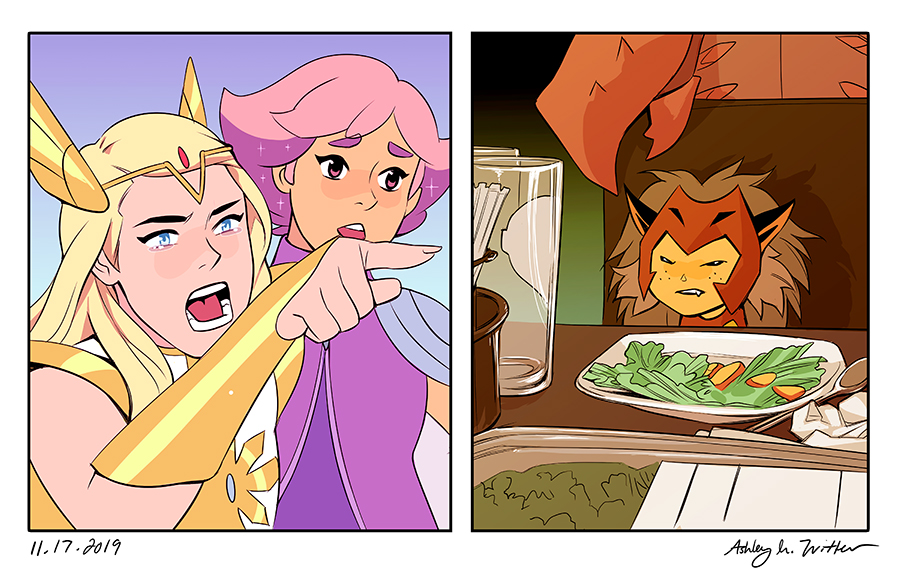
Ok now we can get to the fun part.
The main character, Adora, has a classic character arc: she discovers special abilities and a purpose to fight, but battles her fear of failure, imposter syndrome, and a lack of self-worth. While her journey is peppered with relatable excursions – in ‘Flowers for She-ra’, she nearly failures miserably on her first day of the job, as her premiere clients want her to do something she didn’t know was in her job description – there’s plots that feel almost cookie-cutter: ‘Ties that bind’ features a sub-plot that is pretty much just her and her horse on a admittedly touching team-building exercise.
Catra, the friend she left behind, is a masterclass of self-destructive behavior. It’s clear through the show that she’s experiencing deep emotional pain, both desperate for love and terrified of abandonment. We see through flashbacks that she was denied validation from her only parental unit as a child, and Adora became the extent of her emotional support network. Losing her sets off a cycle of rage, grief and isolation.
Here’s a list of destructive behaviors she commits, in order of occurrence:
- She professes not to care about her own success, when it’s clear it’s only her actions that hold her back
- She refuses her ex-best-friend and love interest’s efforts to renew their friendship – even when she’s trying to comfort her and flirt with her.
- She disregards rules in her workplace
- She attacks the alliance formed by her ex-best-friend, in an attempt to make Adora feel the pain that she feels.
- She challenges dangerous authority figures
- She refuses an opportunity to start a new, happy life with a supportive and possibly romantic relationship
- She manipulates a neurodivergent women to exploit her work, and tries to kill her when she fights back
- When a science experiment (the portal) threatens to collapse time and space, she makes the split-second decision to continue it, preferring the chance of mass-destruction-suicide over failing or being held accountable for her actions.
- She becomes the abuser in a toxic relationship.
- She overworks and mistrusts her direct reports
- She destroys technical equipment during a mental breakdown
- When faced with cult lead by an all-powerful ego-maniac tyrant, she bets her life on her wits alone, instead of immediately seeking an obvious ally.
- She sells out her ex-best friend because she’s coming to rescue someone else.
- Her ‘one good deed’ does not include an escape plan for herself at all.
- When she’s completely on her knees, alone, she laughs in the face of her captor.1
- After getting rescued, she insists on striking out on her own, rather than face the people she hurt
- When she finally gets to a healthy environment, she continues to lash out with negative and catty statements.
- When faced with the possibility that she’s not important enough to her friend to stop her from sacrificing herself to save the world, she runs away with barely an explanation.
Strangely enough, the mass-destruction-suicide attempt isn’t rock bottom for her, but in the context it makes sense: the events happen quickly. Her rage causes her to pursue success at any cost. When the warnings prove true, she states that she’d rather see the world collapse than let the people who hurt her continue on without her. She doesn’t give herself any time to think through her actions. Had she been forced to wait half an hour, would she have tried to find another way to safely open the portal? The drama is in the speed of her actions: her rage is driving her, and she has no chicken brakes on that murder-mobile.
When the threat of mass destruction is subdued, she has to wake up the next day and go back to work. This story line is the effect of a need for climax and reset at the end of the third season, but it’s also relatable – with western stigmas against mental health concerns, moments of grief and self-destruction often go unacknowledged, as we try to truck forward rather than stop and seek help. The evil horde offers no EAP or mental health days, so Catra has to put the whole portal incident behind her as quickly as possible. A major plot point of S4 is that she is haunted by her actions, but unable to discuss them, as the truth would throw her into danger again.
If every villain is a hero in their own world, Catra’s actions are only heroic to her worst personal demons.
Catra does reach rock bottom when she’s completely isolated, both physically and emotionally, as she believes that no one would want to help her. In ‘Corridors’, the episode where she finally turns against the baddies, we get long scenes of her alone in a cold, lifeless environment, with nothing to do but stare at her own reflection and ask herself how she got there. It’s a testament to the writing of the series that the only person she can interact with another women who is dealing with remorse for her previous relationship screw-ups. Glimmer is talking about herself, of course, when she says that she would work on fixing those relationships if given a chance, but it’s clearly news to Catra that fixing relationships was ever an option.
Catra’s long journey into darkness before turning to mental health and acceptance is a great foil to Adora’s process of building up her confidence and finding her self-worth. The story often hints that Adora’s positive relationships with her new friends Bow and Glimmer will be the central narrative, but then veers back to the emotional conflict between her and Catra, allowing that resolution to be the final and most important climax of the series. It gives grown-up viewers an ending that is deeply satisfying, and hopeful to the point of healing.
The only disappointment I have here is that Dreamworks hasn’t put out any official merchandise yet. PLEASE TAKE MY MONEY. I want to buy a t-shirt I can cry into because it’s just too beautiful.
- Oh yeah Catra, you’re so bad.

 Chicago Home Chef Journal
One thought on “She-ra and the Hero’s Journey – Pt. 1: Catra as the relatable villain”