She-ra and the Hero’s Journey, Pt. 3: Protection and Sacrifice

MASSIVE SPOILERS FOR SHERA and THE PRINCESSES OF POWER below the fold.
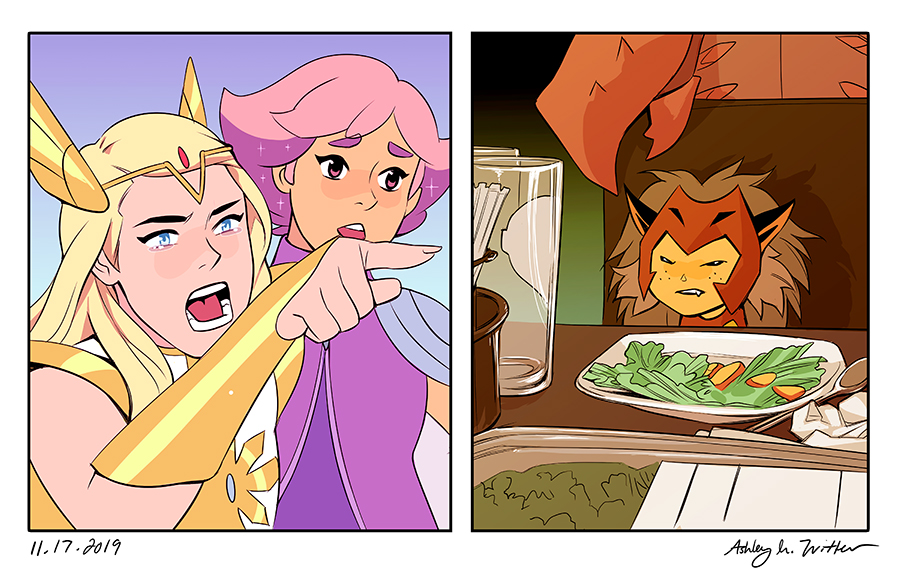
Beyond the battle for good vs. evil, Adora and Catra have a fundamental misunderstanding that drives their conflict.

Adora wants to save her world to protect her friends.

Catra wants to protect her friend to save her world.

This is evident from the beginning: Adora, believing the horde propaganda, is thrilled with her promotion. She intends to follow orders and march into battle, a model soldier. Catra is excited for her until she learns that she will be left behind, and then becomes despondent.

Adora, feeling safe in her world, takes timeout to cheer up Catra, which leads to her discovering the sword. After returning back to the Fright Zone, Adora senses change. She strikes off on her own, leaving Catra behind so that she doesn’t get into trouble.

When they meet again in Thaymor, Adora has turned against the horde as she realizes their philosophy does not fit her world view. She offers Catra the opportunity to join her, but makes it clear she choosing to Save the World over their friendship.

Catra’s main concern for Adora at this point is their personal safety. Yes, she knows the horde is evil, but why is Adora putting her life on the line for two people she just met? In Catra’s mind, their friendship is all that matters, so they might as well stay on the winning side together.

With their friendship put on hold, Catra has to rebuild her world, and decides she has to do it independently. With no best friend to protect, she cares less and less for the world. Her single focus mindset allows her to charge up the ranks of the horde, disregarding Scorpia’s earnest efforts to forge a relationship.

Adora’s generous nature and drive helps her make fast friends and allies, but is often advised to put aside personal relationships to focus on saving the world as a whole, first by Light Hope, and then by Shadow Weaver.

At the start of s5, when they’ve both reached the realm of the wild woman, Adora refuses her friend’s requests to stand down, putting their lives ahead of hers. Catra, believing that there’s nothing left on Etheria for her, continues to view reality as a deadly race up a narrow ladder, and chooses conniving schemes and betrayal to save her own skin.

It only takes one conversation with Glimmer to bring Catra’s to reevaluate her friendship with Adora. Glimmer’s arc in s4 is a play on Adora and Catra’s philosophies: She’s pushing aside her friends to save her world. She uses Adora as bait, disregards Bow and Adora’s advice, refuses their request to save one of their own, and finally manipulates another person to follow her plan, resulting in the foreshadowed disaster. When she speaks to Catra, she easily expresses her remorse, but also her optimism that she could resolve the issues. Catra is reminded of her friendship with Adora when Glimmer asks her about her weird sleeping habits. After she’s forced to sell out Adora to Horde Prime, Catra’s desire to protect her friend is reignited by the memory of a childhood promise to take care of each other. She reshapes her philosophy: Catra must protect her friend, her personal safety and power is no longer important.

Adora’s realm of the wild woman is the loss of her sword, and easy access to She-ra, but she is still determined to save the world to protect her friends. She takes on a mantle of heroism, flying to space to save Queen Glimmer, the forging member of the Princess Alliance, with or without her super powers. While Adora could say “She had me at my at my name,” it takes a more than one conversation to help her find She-ra again, as it’s her love for Catra gives her the clearest path to her superpowers, a direct opposition to her guidance and motivation to focus on saving the world over her personal relationships.

Immediately after Glimmer’s rescue, on a side quest to get more fuel, Adora tells us she is thinking of Catra and her apology, though she doesn’t admit to it until the end of the episode (‘Stranded’). When introducing herself to the Star Siblings, she states that she used to be with the horde, which only adds confusion to a dangerous situation. At this point in the story, she’s been on the opposite side for years; she’s bringing this up because her interaction with Catra is bringing up memories of her time in the Horde. Later, in a situation that definitely called for She-ra, Adora finds that she’s at least able to access the super strength for a moment when she says that she’s ‘not leaving anyone behind’. This could be part of her effort to keep the cave open long enough for everyone to escape, or reference to Catra, who was left behind on Horde Prime’s ship. At the end of the episode, Adora asks Glimmer and Bow to help her rescue Catra; despite everything she’s done, Adora doesn’t want to give up on her. If Adora was focused on her usual task of saving her world to protect her friends, she would would have elected to get back to Etheria to re-unite with the rebellion. Adora breaks her usual protocol to rescue someone whose track record suggests she won’t help the rebellion in the long run.

From this point onward, Adora can only call and keep She-ra when she’s protecting Catra or inspired by her. The first time she fully transforms herself into She-ra is in ‘Save the Cat’, to protect Catra after she agrees to come home to with her. This is also the first time we see She-ra’s new and final look, inspired by the outfits of her friends, including Catra’s helmet. This scene is followed by visuals of She-ra carrying Catra to safety in her arms, reminiscent of the Aztec legend of Popo and Izta as well as other mythic depictions of a strong man carrying a woman in distress.

I just want to pause here to say: may all your redemption arcs involve getting rescued by an 8 foot tall sword heroine.

Adora is able to maintain She-ra long enough to heal Catra from injuries sustained in the fall. In the following episode (‘Taking Control’), the ship is under attack, but Adora is completely focused on Catra. When Catra sees that other people are getting chipped, she expresses a desire to save Etheria for the first time, and then asks Adora to take her home.The funny thing is, Catra has never directly asks to be taken home before; she even stated earlier on Horde Prime’s ship that there was nothing for her on Etheria. Adora understands that Catra doesn’t want to just go back to Etheria, she wants to be on her side again – suddenly, She-ra’s back, and pulls off the most epic fight scene of the entire series.

Back on Etheria, the old patterns re-emerge, with help from Shadow Weaver. Shadow Weaver wants to keep Adora away from Catra, as she wrongly believes that Catra distracts her from her mission to save the world, making her unable to call She-ra. The reality is that Adora’s focus on saving the world is actually what’s keeping her from calling She-ra.

Catra has reverted to protecting her friend to save her world, calling out Shadow Weaver when she encourages Adora to pick up the failsafe without explaining the dangers. As Adora doubles down on her need to save the world, Catra attempts to leave, rather than watch Adora die. When confronted, she asks Adora what she wants, hoping she’ll realize that she doesn’t have to sacrifice herself. Adora insists on continuing with the deadly plan, and Catra leaves. In one of the cutest, sweetest scenes of the series, Catra tells her magical emotional support cat that ‘Adora doesn’t want me, not the way I want her.’ Unable to protect her friend, Catra is seeing her world crumble again.

From this point on, Catra acts with complete selflessness to protect Adora. Catra turns back around when she sees Horde Prime drilling into the heart, and surmises that Adora is in danger. She asks Shadow Weaver to take her Adora, but Shadow Weaver only agrees when Catra shows she wants to go for selfless reasons. Catra is the first to jump into action against the final big monster, and stays by Adora’s side when she tries to go into the heart on her own. Catra is no longer fighting Adora’s need to be a hero – she accepts that Adora will always want to save the world, no matter what the cost.

Adora’s vision of the future is a stark combination of her two goals – the world is not only alive and safe, but she can see herself married to Catra, and she can finally see that her survival and future of true love is what she wants.

Catra’s final act of selflessness is to express her love and complete vulnerability. The long dark night of self-inflicted isolation has ended; Catra has moved past her fear of abandonment that had driven so much of her terrible behavior. She is no longer just protecting herself, she’s ready to open herself up to the world.

With the two stars ready to love each other, Adora can finally push past her need to save the world and allow herself to be She-ra for the people she cares about, and for herself.

She-ra and the Hero’s Journey, Pt. 2: She-ra’s plot on a chart

——Below be SPOILERS for She-ra and the Princesses of Power————

Original artwork by Ashley H. Witter

If you haven’t done so, check out She-ra and the Hero’s Journey, Pt. 1, which breaks down Catra’s destructive behavior and painful fight for redemption and self-acceptance.

Nearly every episode in the series features a step in the hero’s journey for Adora, followed by mirrored step in a mostly wrong direction for Catra. Like a greek tragedy, Catra’s personality flaws prove fatal. Her big turning point occurs through ‘Corridors’, ‘Save the Cat’, and ‘Taking Control’. She sacrifices herself (atonement), gets chipped (death) and then finally accepts Adora’s help, twice (resurrection). Her resurrection actually takes two parts – in ‘Save the Cat,’ her resurrection occurs when she finally allows herself to accept help, but in ‘Taking Control’ she has go through the whole process again, finding rebirth when she realizes it’s only her actions that are blocking her from having any kind of contact with Adora.

Once Catra is firmly on the side of Good and beginning her healing process, Adora then has to tackle her own greek tragedy. Her fatal flaw is her hero complex, shown in a more straightforward way in ‘Heart 2’. She decides to deliver the failsafe as Adora, believing that if she cannot summon She-ra, she has to sacrifice herself (atonement). Horde Prime captures her in the heart, binding her in his evil-prison-matrix (death). Embracing her true desires for a personal, intimate relationship with Catra allows her to call She-ra, and safely deliver the failsafe (resurrection).

Here’s a table of mirroring actions that follow along with the path of Joseph Campbell’s Hero’s Journey:

AdoraCatra
the ordinary worldAdora is hard-working, people-pleasing, full-of-potential senior cadet in the Horde, and supports her close friend Catra, despite Catra’s lack of motivation.Catra is a senior horde cadet whose lack of discipline and toxic attitude makes it difficult for her to impress her teachers or make friends.
Call to adventureHeads out to the woods, finds the swordCatra is tasked with bringing back Adora from the woods
refusing the calldiscovers She-ra cannot be called at will without desireCatra threatens to leave the horde; Catra brags about knowing She-ra’s secrets, but refuses to admit that she knows it’s Adora
Meeting the mentordiscovers Madame Razz in the woods, who helps her commit to She-ra and the rebellion.Catra is berated by Shadow Weaver for faiilng to bring back Adora in the invasion of Thamor.
crossing the first thresholdAdora pledes herself to the rebellionCatra is promoted to force captain
trials, allies, enemiesPrincess alliance is formed, broken by the events of the princess prom and the rescue of Glimmer and BowSuperpal trio of Catra, Scorpia and Entrapta formed with the events of the princess prom and Entrapta’s recruitment.
seeing the shadow selfAdora and Catra confront the dissolution of their relationship in the crystal castle: Adora once again attempts to make amends with Catra, but is forced to see that she cannot make Catra change her toxic behavior.Adora and Catra confront the dissolution of their relationship in the crystal castle: Catra concludes that she doesn’t want Adora to come back to the horde, as she believes that Adora broke her childhood promise to take care of each other and kept her from succeeding on her own.
finding the oracleAdora meets Lighthope, and begins her training. She has more interactions with Angella, as she takes a leadership role in rebellion.Catra captures Shadow Weaver, reversing the pecking order in the horde. Catra is now directly managed by Hordek, who motivates by fear of death. Catra visits Shadow Weaver regularly for advice.
the ordeal/Abyss – the second thresholdTL/DR: a series of events deepens the wedge between Adora and Catra until they manage to destroy and isolate each other.

– Adora successfully defends Brightmoon, building her self-confidence and solidifying the alliance against the horde.

– the portal is opened and closed, teaching Adora to hold Catra responsible for her actions.

– the Heart of Etheria is turned on, nearly destroying all magic, ending with She-ra deleting Lighthope and breaking the sword
TL/DR: a series of events deepens the wedge between Adora and Catra until they manage to destroy and isolate each other.

– Catra attacks Bright Moon, in an effort to destroy Adora’s friends and show Adora the horror of failure.

– Shadow Weaver escapes after manipulating Catra.

– Catra’s rage and grief pushes her to open the portal that she knows will destroy reality.

– Catra atomizes every allegiance she has, suffering an emotional breakdown, fights and disables Hordek, and gets a harsh reality check that kills her will to fight.

– captured by Horde Prime, she is removed from everything familiar to her.
Refusal to returnAdora can no longer call She-ra, insists on putting herself on the front lines. Catra attempts to manipute Horde Prime, as she did with Hordek.
rescue from withoutAdora discovers that she can access She-ra on her own when she rescues Catra from Horde PrimeCatra, after getting brainwashed, is rescued from horde prime by She-ra
death of dreamsAdora decides she must sacrifice herself to deliver the failsafe if she cannot become She-ra. She concludes that she must focus on saving the world to succeed, going out on her own.Catra fears that Adora will sacrifice herself to deliver the failsafe, concludes Adora does not want her and Catra’s true feelings will only hinder any chance she has at success
Third threshold – a sacrifceMara tells Adora that she is worthy of love, but Adora still continues her quest to deliver the failsafeCatra convinces Shadow Weaver to take her to Adora, pushing aside her fear of honesty and self-awareness to protect her as long as she can.
Climax and CatharsisOn discovering that Catra has always loved her, and telling her she returns her feelings, Adora is able to call She-ra.Catra refuses to leave Adora, and admits her true feelings
resurrectionShe-ra’s back! She delivers the failsafe, shutting down the heart, and returning topside to fight the horde.Catra seals their relationship into unambiguous canon with a kiss. Catra’s relationship with Adora is fully restored, with more honesty and health than ever before.
Master of worldsShe-ra destroys Horde Prime, and accepts Hordek’s surrenderCatra finds forgiveness and acceptance from others and herself.
Freedom to liveAdora proposes the mission to restore magic to the galaxyCatra is able to openly express her love for Adora, and is accepted into the BFS.

As I went through this, I realized there are multiple ways to apply the hero’s journey to the story. The first season, which for American TV shows usually has to stand on its own, has Adora marching through a simplified journey. In ‘The Battle of Bright Moon”, Adora goes through some of the last steps of the journey without Catra, getting herself and the remaining members of alliance captured (death), the prodigal members return to the support Bright Moon (rescue), She-ra is able to fight and lead again (resurrection), and the alliance combines their magic to beat off the horde (master of worlds and Freedom to Live).

As demonstrated in the differences between the opening paragraph and the table, Adora and Catra’s return process is not exactly in lock step. Initially, The drivers of the actions set the journey out of step. At the start, it’s Adora’s discovery of She-ra that kicks off the story, while Catra’s departure journey is one of reaction. While Adora actively cycles through mini-journeys to solidify her friendship with Bow and Glimmer, Catra is watching from afar and following orders. Catra threatens to leave the horde, as much as it sounds like angry bluffing (refusal of the call). Shadow Weaver forces to go to Thaymor to try to rescue Adora (supernatural aid). She reappears late in ‘The Sword pt. 2’ when She-ra has clearly been pushed over a lot of initial crossover thresholds as she realizes the Horde is evil. Catra’s crossover comes when she refuses Adora’s offer to join her. In this moment, her fear of abandonment and the unknown causes the first major rift between the two friends (crossing the first threshold). For both of them, they cycle through the departure steps again, this time with mentors (Razz and Shadow Weaver) and higher stakes: Adora attacks of the horde base and Catra gets sent to the principal’s office (Belly of the Whale). This concludes in the nail-in-the-coffin departure threshold: Adora is squarely pledged to the side of Good, and Catra is cackling with “I’ll show them” laughter on the side of Bad.

Contrast this to the end, where Adora is so attached to her destiny that she chooses to be a good soldier, following Shadow Weaver’s orders and accepting her death as inevitable. Catra is now the one to drive change, as she steps in to fight the final monster (sacrifice), resists Adora’s urge to leave her, and saves Adora with a confession of her true feelings (transformation).

To make a good story, Adora’s final steps have to come at the very end, but to demonstrate the difficulty of finding mental health and restoring relationships, Catra has to go through the process in smaller and smaller cycles with diminishing stakes to her personal safety. While the final conflict is against a villain destroying the galaxy, Catra is completely focused on her selfless effort to keep her friend alive, putting the conflict between her own feelings and her fear of vulnerability. While there is an overarching conflict between life and death, in the final moments, Catra chooses this personal fight over, for example, going directly after Horde Prime or trying to escape.

The events between the finale of season one and the end of season four are lumped into the Abyss. The 26 episodes of Abyss is a product of our current television programming standards. While the show runner initially and successfully mapped out 52 episodes, American television always has to format the shows in seasonal arcs, with the constant threat of getting cancelled before they can produce a satisfactory ending. One critical benefit of streaming platforms is the ability to lesson the threat of cancellation for their original offerings. They’re not dependent on advertisers, thrown off by competing shows in the time-slots, and are basically able to set their own schedule, as their income is subscription-based rather cost-per-view. Still, there’s always a chance that a show could get dropped before the show runners had planned, or that it’s so popular that the show runners are forced to extend the story to its breaking point (see ABC’s television program ‘Lost‘).

So She-ra’s first season wraps up Adora’s hero’s journey at least to overcome the first big battle and form an alliance that wins with a victory rainbow(Freedom to Live). Younger viewers might be completely satisfied with this ending: our hero wins, she saves her friends, the enemy is pushed back. When the season first aired, older viewers, especially those who enjoyed the fabulous dance scene of ‘Princess Prom’, probably assumed that the arc would continue as many children’s programming as in the past: villain supplies monster, hero defeats monster, repeat until final boss.

The big trend today is redemption, as our cultural values shift towards trying to see beyond ‘good and bad’. With the initial season of She-ra, Catra and the horde are so thoroughly coded as evil that it’s difficult to imagine reconciliation for them. The solution is to end the season with the simplified journey for Adora that younger viewers can easily latch on to, while giving the main villain such a strong, relatable and at times extremely enjoyable personality that older viewers find themselves latching on to her much more subtle storyline.

The characters are finally able to leave the abyss and enter the magic flight at the end of season 4: Adora’s sword is broken, Catra’s standing over Hordek is trashed, and at one point she symbolically removes her helmet in one of the most brutal scenes. She reports in to Hordek with a voice and face of utter restraint, and upon switching off the video call, loses complete control of her emotions. While she’s able to put her helmet on again in the episode, this scene represents her leaving a lot of her immediate emotional drivers behind – the tears overwhelm, flow out, and she becomes devoid of feelings, losing most of her ability to fight back or effectively stick up for herself. Her state of inaction (realm of the wild woman) continues until she’s thrown into the two-person support group on horde prime’s ship, finally getting her to see that her personal safety is actually connected to the safety of others in her life, and that her actions can have positive effects if she just accepts help and guidance.

She-ra and the Hero’s Journey – Pt. 1: Catra as the relatable villain

Or can we say . . the heroine’s journey? the She-ra-oine’s journey?

I’ve been stuck on She-ra and the Princesses of Power since the last season came out two weeks ago. There’s a lot to love about this show, but I’m mostly just enamored with the craftsmanship of the story.

If you haven’t figured it out by now, I’m about to SPOIL ALL OF SHE-RA.

Yes, I acknowledge it is meant for younger viewers: there’s a full plate of Winning with the POwEr Of FrIeNdShIP, tempered by clever dialog and strong character development. In the first four seasons, almost every episode balances two sides of the major conflict between good and evil, with the ‘Hero’ characters tackling positive aspects of a theme, providing the most teachable moments masquerading as emotional conflicts with quick resolutions. The ‘Villain’ side of the story is mostly mirrored plot points that build fascinating character dynamics and Game-of-Thones-worthy drama, completely free of the ‘quick clean-up’ apologies and reliance on teamwork as a resolution. The main villain of the story is deeply relatable, and the relationship between her and the main hero is an emotional rollercoaster that gets the audience to hope for a happy ending and dream of a gratifying redemption, while fearing that it neither may be possible.

HAVE I CONVINCED YOU TO FIRE UP NETFLIX AND WATCH IT YET? Ok I’ll bring up one more point: the representation game is strong with this one. She-ra features stable same-sex couples, as well as diverse body types and backgrounds. If you’ve ever felt that a comfort food show featuring lesbian relationships was missing from your life . . . don’t let me spoil it for you. Just watch it!

BELOW BE THE SPOILERS!!!!

————————————BEWARE, YE WHO HAVE NOT WATCHED SHE-RA YET————————

Ok now we can get to the fun part.

The main character, Adora, has a classic character arc: she discovers special abilities and a purpose to fight, but battles her fear of failure, imposter syndrome, and a lack of self-worth. While her journey is peppered with relatable excursions – in ‘Flowers for She-ra’, she nearly failures miserably on her first day of the job, as her premiere clients want her to do something she didn’t know was in her job description – there’s plots that feel almost cookie-cutter: ‘Ties that bind’ features a sub-plot that is pretty much just her and her horse on a admittedly touching team-building exercise.

Catra, the friend she left behind, is a masterclass of self-destructive behavior. It’s clear through the show that she’s experiencing deep emotional pain, both desperate for love and terrified of abandonment. We see through flashbacks that she was denied validation from her only parental unit as a child, and Adora became the extent of her emotional support network. Losing her sets off a cycle of rage, grief and isolation.

Here’s a list of destructive behaviors she commits, in order of occurrence:

  • She professes not to care about her own success, when it’s clear it’s only her actions that hold her back
  • She refuses her ex-best-friend and love interest’s efforts to renew their friendship – even when she’s trying to comfort her and flirt with her.
  • She disregards rules in her workplace
  • She attacks the alliance formed by her ex-best-friend, in an attempt to make Adora feel the pain that she feels.
  • She challenges dangerous authority figures
  • She refuses an opportunity to start a new, happy life with a supportive and possibly romantic relationship
  • She manipulates a neurodivergent women to exploit her work, and tries to kill her when she fights back
  • When a science experiment (the portal) threatens to collapse time and space, she makes the split-second decision to continue it, preferring the chance of mass-destruction-suicide over failing or being held accountable for her actions.
  • She becomes the abuser in a toxic relationship.
  • She overworks and mistrusts her direct reports
  • She destroys technical equipment during a mental breakdown
  • When faced with cult lead by an all-powerful ego-maniac tyrant, she bets her life on her wits alone, instead of immediately seeking an obvious ally.
  • She sells out her ex-best friend because she’s coming to rescue someone else.
  • Her ‘one good deed’ does not include an escape plan for herself at all.
  • When she’s completely on her knees, alone, she laughs in the face of her captor.1
  • After getting rescued, she insists on striking out on her own, rather than face the people she hurt
  • When she finally gets to a healthy environment, she continues to lash out with negative and catty statements.
  • When faced with the possibility that she’s not important enough to her friend to stop her from sacrificing herself to save the world, she runs away with barely an explanation.

Strangely enough, the mass-destruction-suicide attempt isn’t rock bottom for her, but in the context it makes sense: the events happen quickly. Her rage causes her to pursue success at any cost. When the warnings prove true, she states that she’d rather see the world collapse than let the people who hurt her continue on without her. She doesn’t give herself any time to think through her actions. Had she been forced to wait half an hour, would she have tried to find another way to safely open the portal? The drama is in the speed of her actions: her rage is driving her, and she has no chicken brakes on that murder-mobile.

When the threat of mass destruction is subdued, she has to wake up the next day and go back to work. This story line is the effect of a need for climax and reset at the end of the third season, but it’s also relatable – with western stigmas against mental health concerns, moments of grief and self-destruction often go unacknowledged, as we try to truck forward rather than stop and seek help. The evil horde offers no EAP or mental health days, so Catra has to put the whole portal incident behind her as quickly as possible. A major plot point of S4 is that she is haunted by her actions, but unable to discuss them, as the truth would throw her into danger again.

If every villain is a hero in their own world, Catra’s actions are only heroic to her worst personal demons.

Catra does reach rock bottom when she’s completely isolated, both physically and emotionally, as she believes that no one would want to help her. In ‘Corridors’, the episode where she finally turns against the baddies, we get long scenes of her alone in a cold, lifeless environment, with nothing to do but stare at her own reflection and ask herself how she got there. It’s a testament to the writing of the series that the only person she can interact with another women who is dealing with remorse for her previous relationship screw-ups. Glimmer is talking about herself, of course, when she says that she would work on fixing those relationships if given a chance, but it’s clearly news to Catra that fixing relationships was ever an option.

Catra’s long journey into darkness before turning to mental health and acceptance is a great foil to Adora’s process of building up her confidence and finding her self-worth. The story often hints that Adora’s positive relationships with her new friends Bow and Glimmer will be the central narrative, but then veers back to the emotional conflict between her and Catra, allowing that resolution to be the final and most important climax of the series. It gives grown-up viewers an ending that is deeply satisfying, and hopeful to the point of healing.

The only disappointment I have here is that Dreamworks hasn’t put out any official merchandise yet. PLEASE TAKE MY MONEY. I want to buy a t-shirt I can cry into because it’s just too beautiful.

  1. Oh yeah Catra, you’re so bad.

‘Springster’ celebrations

SPRINGSTER MENU

Lamb Shoulder with Honey, Herbs and Lemon-Caper relish – by Diana Henry, posted by the Telegraph but also available from her book From Oven to Table

Baby Kale Salad – from the Sweet Home Cafe cookbook

Ingredients:

for the croutons:

  • 1 cup cubed corn bread, in 1/2 inch cubes

for the buttermilk dressing:

  • 3/4 cup buttermilk, preferably full fat
  • 2 tablespoons mayonnaise (Duke’s is recommended)
  • 1 teaspoon dijon mustard
  • 1 teaspoon cider vinegar
  • 1 tablespoon freshly squeezed lemon juice
  • 1 scallion, white and green parts, thinly sliced
  • 1/4 cup snipped fresh chives
  • 1 small garlic clove, chopped into a paste
  • 1/2 kosher salt
  • freshly ground black pepper

for the salad:

  • 1 cup toasted corn kernels
  • 1 teaspoon extra virgin olive oil
  • 1 pound baby kale
  • 1/2 cup cooked black eye peas, preferably from fresh or frozen, not canned
  • 1 cup cherry or grape tomatoes, halved

To make the croutons:

Preheat the oven to 275 degrees. Spread the corn bread on a baking sheet and bake until lightly golden and crisp, about 20 minutes. Let cool completely.

To make the buttermilk dressing:

Combine all the ingredients in a small bowl and whisk until well blended. If not using immediately, transfer to an airtight container and refrigerate for up to 3 days.

to make the salad:

Heat a medium cast-iron skillet over high heat. Add the olive oil and corn and cook, stirring, until the kernels are fragrant and begin to char, about 2 minutes, Transfer to a plate to cool.

Combine the kale, cooled corn, black-eyed peas, and tomatoes in a large bowl. Add enough dressing to lightly coat the kale and other vegetables and toss to coat evenly. Transfer to a serving bowl, garnish with croutons, and serve

Old Fashioned Strawberry pie from The Norske Nook Book of Pies

Makes one 11-inch pie

Ingredients:

  • 1 double crust (There’s lots of recipes for pie crust but I just get store-bought)
  • 10 cups strawberries, quartered
  • 1 1/2 cups granulated sugar
  • 7 tablespoons cornstarch
  • 3 tablespoons salted butter, melted
  • 1/4 cup sanding sugar (coarsely ground white sugar) for sprinkling

Preheat the oven to 375 degress.

Place the bottom layer of crust over your pie pan.

Place the strawberries in a bowl and add the sugar and cornstarch. mix well and place the mixture in the crust.

Cover the pie with the remaining crust, crimp around the rim, and cut slits in the top. Brush with melted butter and sprinkle with sanding sugar.

bake until a knife comes out clear, and not sugary, about 2 hours.

VEGETARIAN/VEGAN OPTION:

Vegetarian Mushroom Wellington: from NYT cooking, easy vegan substitutes in the recipe.

THOUGHTS AND REASONINGS

Chicago is deep in the Great Hunkering, right on top of the time that I normally indulge in a cobbled set of traditions around Lent and Easter. All of that has been cancelled, with some mixed feelings.

Springtime is usually very hectic for me – there’s a yearly early music conference, a new annual tradition of a cover rock band fundraiser, and preparations for series of masses with music in English, Spanish, and Tagalog. The music for the masses rarely changes, but the choirs still meet to review and practice, along with violins, guitars, and sometimes a harp or a trombone.

While this is going on, people are decorating the church. Lent inspires minimalist, hardy decor – my personal favorite from past years featured cacti and succulents. As we get closer to the big reveal a group of people come in to build a small wooden room within the church and use paper-mache to make it resemble a stone tomb, which gets filled with statues of a woman who looks devout and and a reclined man who looks, well, terminally inconvenienced.

This is the time of year that many Catholics practice what I like to call ‘religion-oriented selective meat abstinence’ because it’s only on Friday, and we’re only supposed to eat animals that are considered ‘aquatic’ – this definition is based on ancient categories of animals that hung out in water. By this logic, chicken is out, duck is in, confusion abounds.

Since I try to complete all my food prepping on Sunday, to make things easy during Lent, I make vegetarian meals. I love the concept of vegetarian diet but I’m challenged by the commitment – but I think this is the point of Lent. We’re meant to be reminded that for most of the course of human history, there was no meandering over to the grocery store to lazily pick up a cooked-and-ready rotisserie chicken just because we craved it, and for most people in this world today, these kinds of luxuries are still unreachable. In this time of year, for a subsistence farmer, everything would depend on stretching out the stored vegetables and grains until the weather was warm enough for wild plants and animals to return.

It all culminates in one crazy weekend that starts with “The foot-washing mass” on Thursday night, then two services on Friday night (I would usually sneak a light beer in between the masses if I’m singing in the Spanish mass). The Friday night service involves specific prayers for Christians of other denominations, atheists, and followers of Jewish faith. The prayers are specific but can all be summed up as “mutual success, excellence, and spiritual wellbeing.” Often the Friday night service coincides with Passover celebrations, and when the prayers come up I think of a dear friend of mine who moved away a few years ago, so I reach out and we text back and forth after the mass to catch up.

But we’re not done yet! Easter Vigil on Saturday night is a lengthy mass incorporating three languages, confirmation and baptism ceremonies, and lots of music. At some point the statue of the man is removed from the little stone tomb and everyone rejoices. People go out and celebrate late into the night, and then come back to the church for an Easter Sunday mass with full-on flowers, upbeat music, and parents dress up their kids in the cutest dresses and suits, AND WE’RE FINALLY DONE. No more special rehearsals, no more dietary restrictions – just back to ordinary life and putting away all the heavy sweaters and scarves.

I like to top off the day with a small dinner party to celebrate. I always make lamb, a leafy green side, and a pie. Mom comes over and we break out the fancy china and the colorful tablecloth.

A lot of this is not happening this year. The Vatican has wisely declared that we are banned from gathering physically until further notice. Services are streamed over the internet, and the things we used to do – decorations, building, music rehearsals are all now health hazards, and will be until longer after Easter is over. In other obligations the early music conference is cancelled, the rock band fundraiser is postponed, spring travel plans are now in wait-and-see mode.

This time of year, I’m usually making choices – rehearsals, masses and performances overlap, and sometimes run long, making demands on my voice and my patience. I get sick of lentils. I have to practice all the time. I don’t love every song I perform. When I have down time I get reflective. This year I have nothing but time – time to check the news, time to try to use up leftover cake flour, time to worry about the future, time to review past choices, time to grieve people who have been lost, time to pet the cat.

The cat is no longer interested in my attempts to pet her.

But it’s also time to think about what I’m going to make when Lent ends and I can once again consider the butcher. I won’t be singing the Easter mass but I’m sticking to the original recipe plan I made up a few months ago.

Since I can’t have Mom over, I decided to write up the recipes I chose so that she can either copy them or make something similar, and we’ll try to coordinate some face-time. I’m posting here for anyone else who’s looking for a celebratory meal idea, and I’m going to call it “Springster” because it’s more inclusive, better reflects how I think about Easter, and implies that perhaps by April 12th we’ll know the “Spring” date – the date the epidemiologists spring us from shelter-in-place orders.

Reach out to me if you want to connect – I’d love to get a big call going so we can share what we’ve made and how we’ve brought a little bit of renewal and growth into our bunkers.

Me Me Me

By day I play with computers. By night I sleep.

On the weekends, I’m busy. I like to make music! I like to read books! I’m trying to write books! I’m trying to stay healthy. I’m trying to keep my relationships healthy. I’m trying to keep my bank account in the black.

I have a lot of cookbooks.

A couple years ago, when I wasn’t that good at cooking, I created a plan: put all the recipes in a spreadsheet. Work through them one by one. I started noticing patterns, I got more ambitious, I started to enjoy it. Now I want to share it.

On most weekends, I meal prep. I always at least make lunch for myself and Mr. BF. eight salads consisting of lettuce, kale, one of those bags of raw vegetable blends, a stuffed grape leaf, and some chopped up lunch meat. Lately Mr. BF has been pan-frying some chicken to replace the lunch meat.

When time allows (which is most Sundays) I pick something from the big recipe spreadsheet and I cook it! And I take a lot of notes.

I will add pictures . . . . As soon as the computer start cooperating . . .